
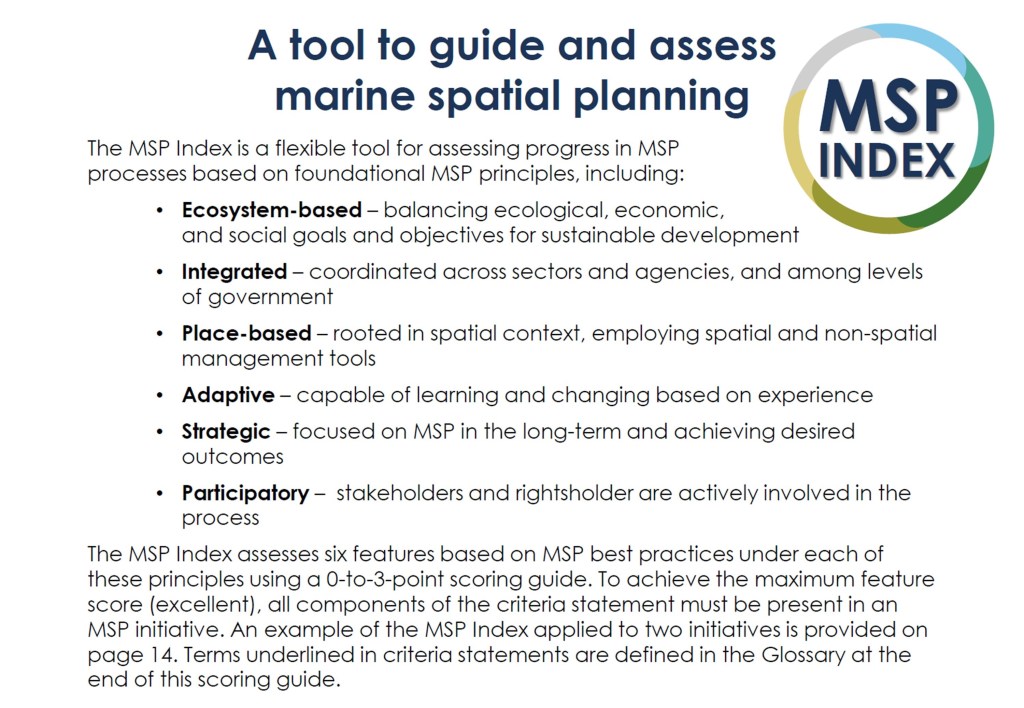
The MSP Index assesses the extent to which six foundational MSP principles are present in MSP initiatives: ecosystem-based, integrated, place-based, adaptive, strategic, and participatory.
Under each of these principles, the MSP Index identifies six features. Features are the distinct attributes of MSP principles that, when implemented, ensure principles are present in MSP (e.g., biodiversity conservation is a feature of the ecosystem-based principle).
Features are defined by criteria statements to be effectively implemented (e.g., to effectively implement biodiversity conservation, management measures must exist to maintain or restore biodiversity, their habitats, and ecological processes).
The MSP Index uses these criteria statements as the basis for its scoring guide, where each feature is scored from zero to three points based on the inclusion of criteria in MSP initiatives. To achieve the maximum feature score (excellent), all elements of the criteria statement must be present in an MSP initiative.
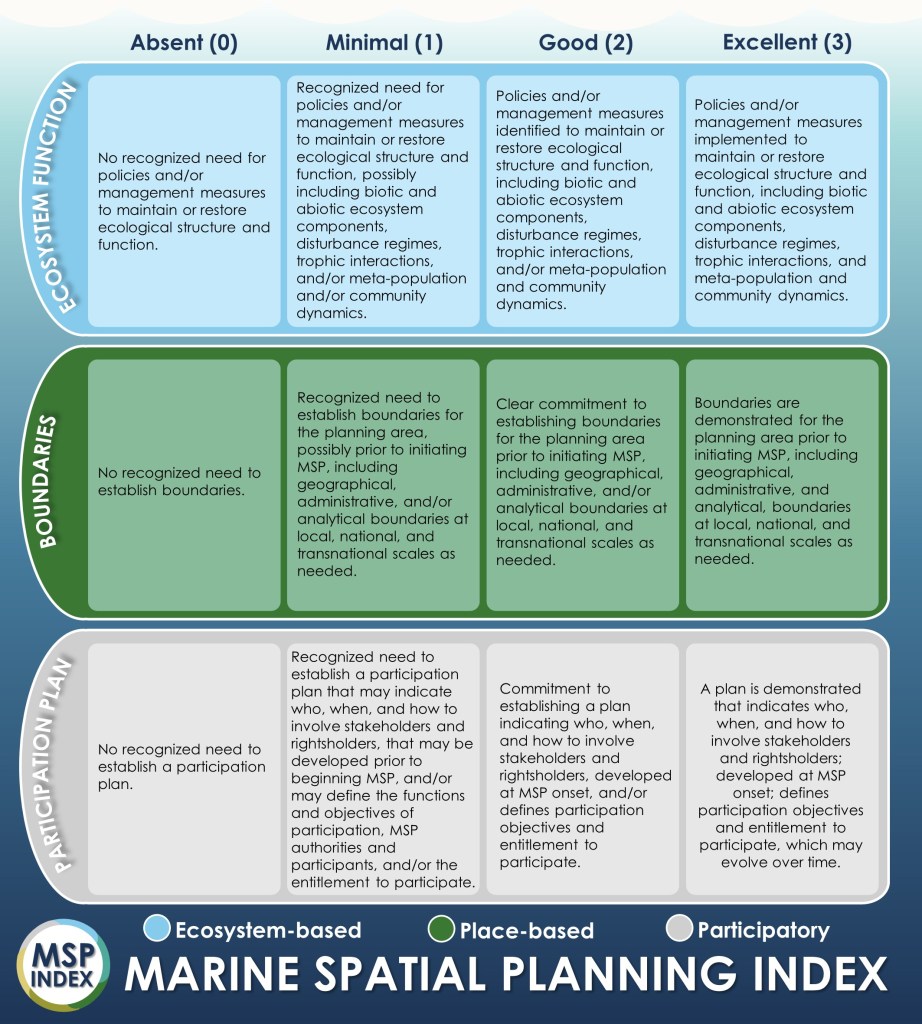
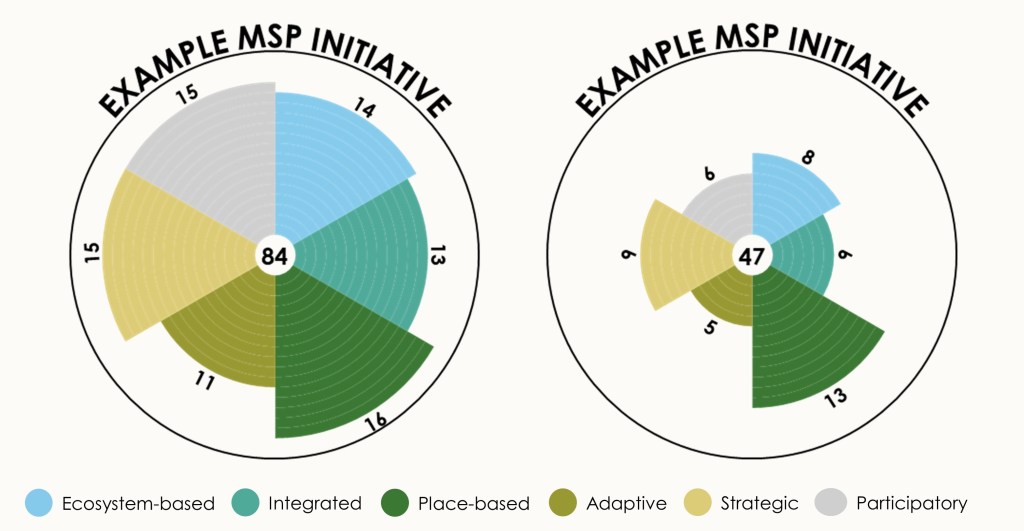
To use the MSP Index, it’s as simple as reviewing the criteria statements and determining which score is most appropriate for each of the 36 key features. Feature scores are then summed to give MSP Principle Scores (out of 18), and these are summed to give a final MSP Index Scores (out of 108).
In this example, the principle score is at the outset edge of each petal and the MSP Index score is at the center of the diagram.
Using the MSP Index requires significant knowledge of the assessed initiative(s). This can be achieved through use of public content, policy and management documents, scientific literature, and expert knowledge — but it is best when used by MSP practitioners who are actively involved in MSP as it evolves.
The complete MSP Index scoring guide is available here.
 marine spatial planning index